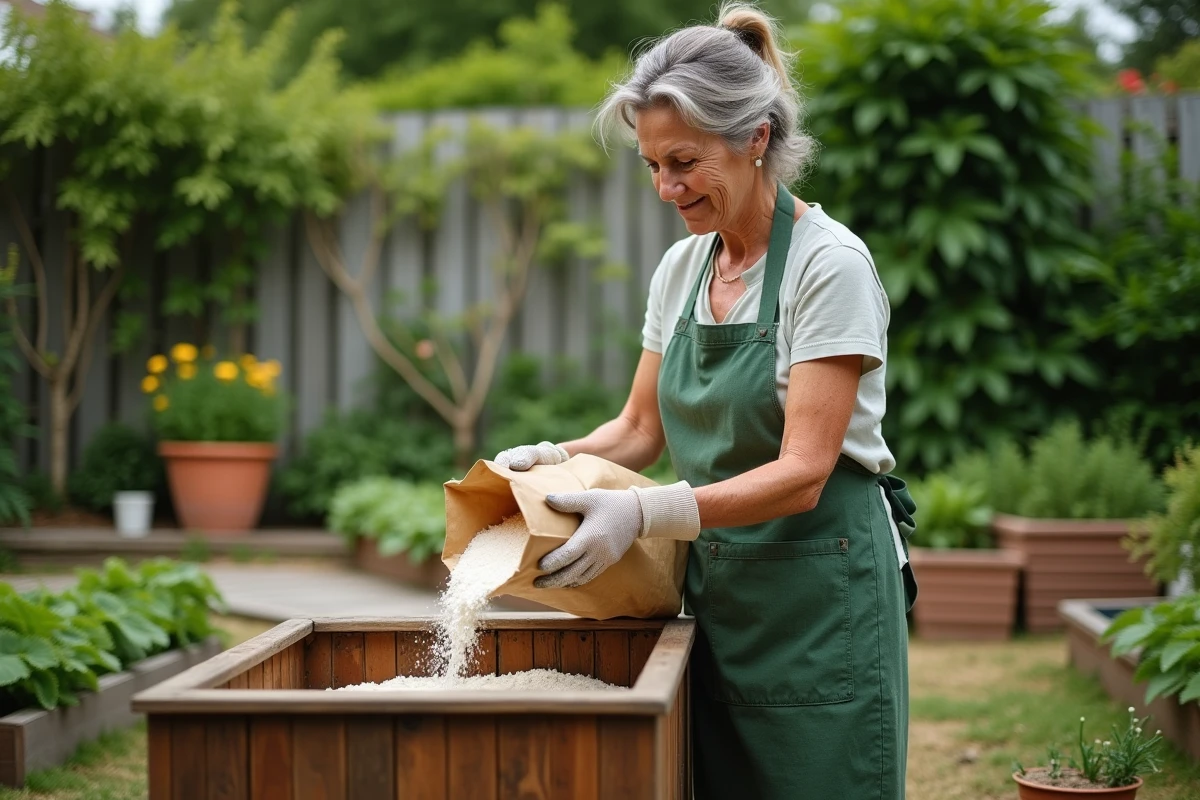
Every year, bags of flour forgotten at the back of a cupboard end up in the trash. Expired flour, as long as it shows no signs of mold or insect infestation, remains an organic waste rich in starch that decomposes. Adding it to the garden compost seems logical, but the practice raises concrete questions about microbial behavior, pests, and acceptable quantities.
Flour and microbial activity: a decomposition accelerator to master
The least addressed angle regarding flour in compost concerns its role as a microbial starter. The starch it contains serves as a substrate easily assimilated by thermophilic bacteria, the ones that raise the temperature of the pile.
Composting trials conducted by the Urban Agriculture Institute of Montreal during its 2022-2023 demonstration program report that a moderate and well-mixed addition of starch-rich waste (stale bread and expired flour) significantly increases the temperature rise within the first 48 hours. The condition: maintain a good carbon/nitrogen ratio and sufficient aeration.
In practical terms, flour acts as a quick fuel for microorganisms. The use of expired flour in compost is best thought of as a targeted and occasional addition, not as a complete cupboard emptying all at once.
This accelerated temperature rise has a secondary advantage: it helps destroy some of the weed seeds and pathogens present in the pile. On the other hand, an excess of unmixed flour produces the opposite effect, creating a compact and anaerobic mass that ferments instead of composting.
Carbon-nitrogen ratio of flour: classifying this waste for better dosing
Flour does not fit into the usual categories of home composting. It is neither a green material (rich in nitrogen, moist) nor a classic brown material (dead leaves, cardboard). Its C/N ratio places it in an intermediate zone, closer to carbonaceous materials than to fresh kitchen waste.
This particularity explains why flour behaves differently from vegetable peels in the composter. It absorbs moisture, forms compact aggregates, and cuts off air circulation if poured in a thick layer.
How to integrate flour without creating a compact block
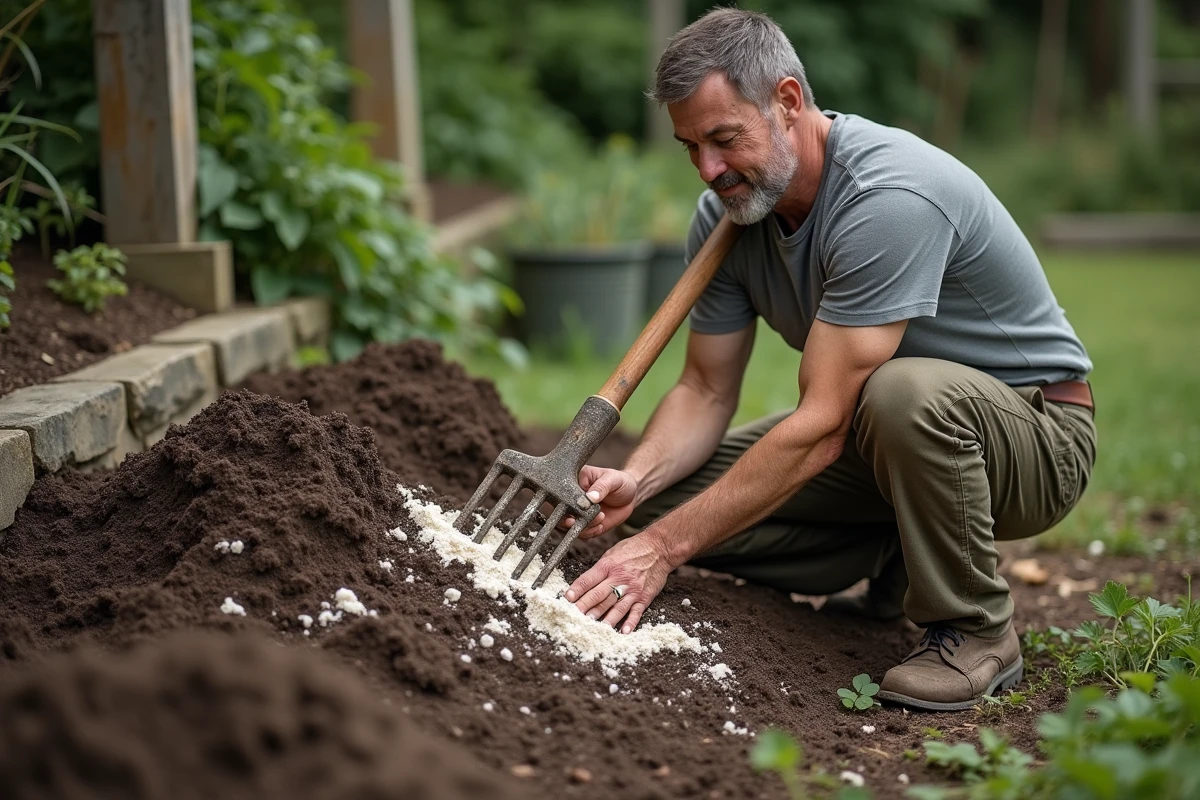
- Sprinkle flour in a thin layer (a few millimeters) between two layers of structuring materials like branch chippings, dead leaves, or shredded cardboard
- Immediately mix with the lower layer using a fork or compost turner to break up any initial clumps
- Space out flour additions by at least two to three weeks to allow microorganisms time to process the available starch
- Avoid adding flour during rainy weather, as water turns the powder into a sticky paste that is almost impermeable to air
The principle remains the same as for any starch-rich waste: dispersion takes precedence over quantity. Emptying an entire bag at once creates problems; the same amount spread over several weeks goes unnoticed in the decomposition process.
Pests and communal composters: flour under regulatory surveillance
Field reports vary on this point depending on the type of composter used. In a closed bin at the back of a private garden, a moderate addition of expired flour generally does not pose major issues. The situation changes with shared or building foot composters.
The Réseau Compost Citoyen Grand Est recommends, in its 2023-2024 training sessions, to limit the addition of bread, pasta, and flour in communal composters. The main reason: these materials attract rats and fruit flies, especially when they are not properly buried by all users.
This recommendation does not stem from a national legal prohibition. It arises from practical feedback accumulated by master composters in the field. In a home composter where one person controls the inputs and mixing, the constraint is lessened.
Wheat flour, rye flour, whole flour: different behaviors
Not all flours react the same way in compost. Refined white flour, almost pure starch, decomposes quickly but more easily forms sticky clumps. Whole flour contains more fibers and minerals, making it slightly easier to integrate into the process.
Whole rye or spelt flour mixes better with brown materials than white T45 or T55 flour. If you have a choice among several expired bags, start with the whole flours.
Maximum amount of flour per composting cycle
No published scientific data sets a precise threshold in grams per liter of compost. The available data do not allow for a universal dosage conclusion, as the absorption capacity depends on the total volume of the pile, its maturity, and the proportion of structuring materials already present.
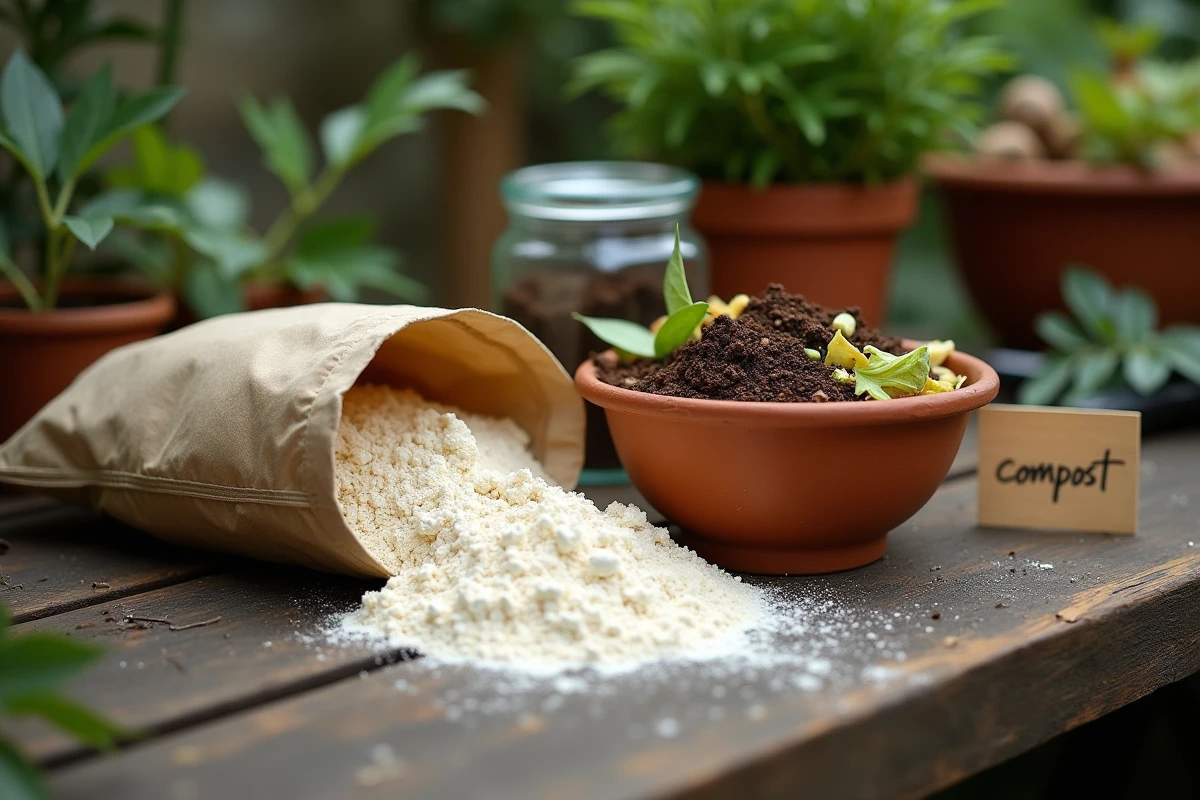
An empirical guideline shared by several home composting guides: flour should never represent more than a small fraction of the weekly inputs. The equivalent of a few handfuls per week for a standard-sized composter is sufficient to enjoy the starter effect without risking imbalance.
Beyond that, two warning signals should trigger a temporary halt to flour additions:
- A persistent sour or yeast smell, indicating anaerobic fermentation rather than aerobic composting
- The presence of white or gray crusts on the surface, indicating that the flour is not decomposed and is forming a plug
- An increase in fruit flies around the composter, especially during warm periods
If any of these signals appear, vigorous mixing and a massive addition of dry materials (dead leaves, torn corrugated cardboard) usually help restore balance within a few days.
Expired flour in compost works, provided it is treated as an occasional supplement and not as waste to be disposed of in bulk. The useful gesture can be summed up in three words: little, dispersed, mixed. A well-mixed composter rich in brown materials easily digests what the kitchen cupboard has forgotten.