
The cucumber-lettuce association relies on a root complementarity that is often underestimated. Lettuce, with its shallow roots, exploits the nutrients in the upper layer of the soil, while cucumber draws from deeper levels. This stratification limits excess nitrogen at the surface, a factor that promotes certain pests and foliar diseases on cucurbits.
Root Stratification and Nitrogen Management in the Vegetable Garden
We regularly observe in plots where cucumber and lettuce coexist a better distribution of fertility. The cucumber, with its root system extending much deeper than that of the lettuce, seeks water and mineral elements from horizons that lettuce does not colonize.
The concrete result: less excess nitrogen at the surface reduces fungal pressure on cucumber leaves. Aphids, attracted by nitrogen-rich tissues, also find fewer easily accessible resources. This is not a spectacular mechanism, but over a full season, the health difference is visibly measurable.
For those who wish to grow cucumber and lettuce in the vegetable garden by taking advantage of this complementarity, the positioning of the rows is as important as the choice of varieties. We recommend placing the lettuces on the north or east side of the trellised cucumber row, where the shading will be gradual without becoming total.
Intercropping: Planting Lettuce Before Cucumber
The most effective technique is to install the lettuces as an early intercrop, three to four weeks before planting the cucumbers. The lettuces occupy the space between the future rows of cucurbits and produce most of their harvest before the cucumber foliage creates too much shade.
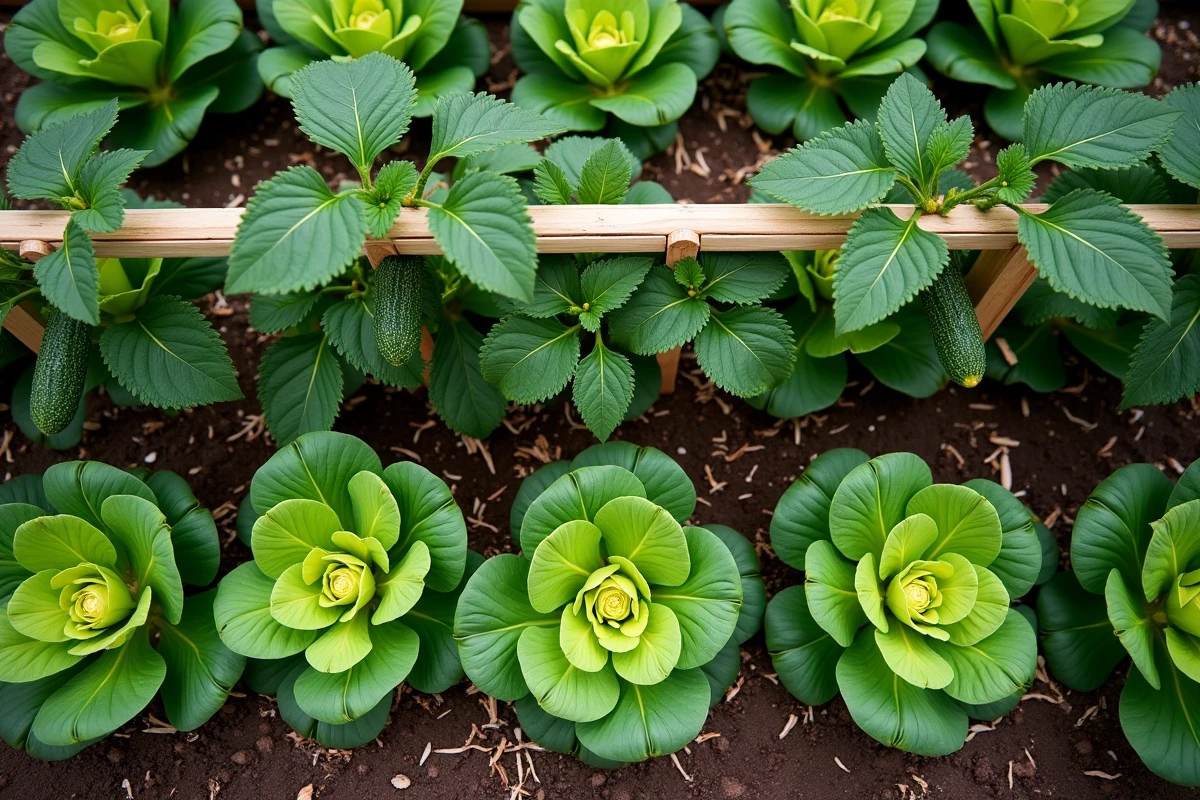
This temporal offset transforms a spatial association into a true accelerated rotation on the same bed. Lettuce structures the upper layer of the soil, maintains moisture with its cover, and then gives way when the cucumber enters its rapid growth phase.
Typical Planting Schedule
- Sowing or transplanting lettuces as soon as the soil reaches a stable temperature above the germination threshold, usually in April depending on the regions
- Planting cucumbers in the ground once frost is no longer a concern, when the lettuces are already well developed
- Harvesting the majority of the lettuces in the weeks following the installation of the cucumbers, before the shading becomes dense
- Possibility of replanting a second series of summer lettuces under the cover of the trellised cucumbers, this time taking advantage of the shade as an asset against the heat
Cucumber Shade and Lettuce Bolting in Summer
The light shade from cucumber foliage delays the bolting of lettuces. During periods of intense heat, lettuces grown in full sun bolt quickly and become bitter. Under a trellised cucumber, the soil temperature drops by a few degrees, extending the harvest window.
We recommend systematically trellising cucumbers when they are associated with lettuce. A sprawling cucumber covers the ground chaotically and eventually suffocates the lettuces. Trellised on a lattice or vertical net, it casts a filtered, regular shade that is compatible with lettuce photosynthesis.
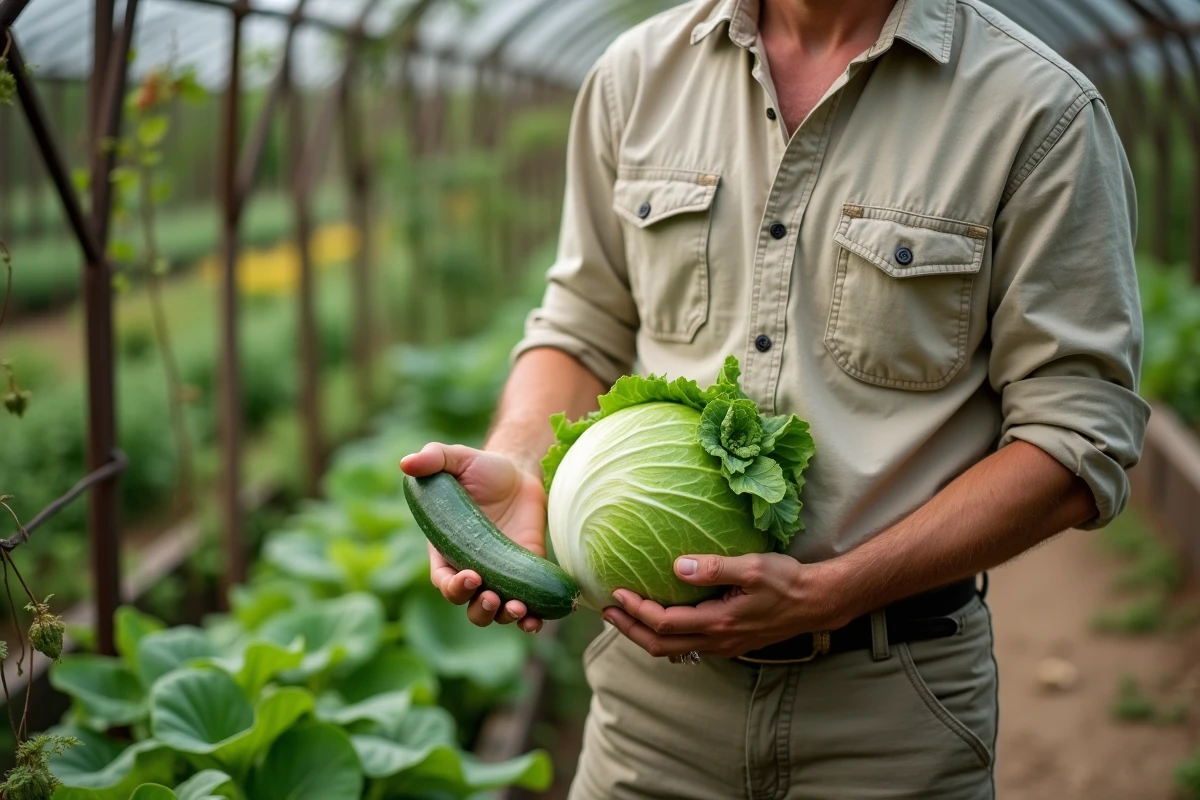
Watering remains the main point of vigilance. Cucumber is demanding in water, and so is lettuce, but in a different way: it fears excess at the collar. A coarse mulch such as wood chips or dry straw satisfies both crops. It maintains moisture deep down for the cucumber while avoiding direct contact of water with the base of the lettuces.
Slugs and Mulching: A Positive Side Effect
Recent reports from shared gardens indicate a reduction in slug pressure on lettuce when it is associated with mulched cucumber rows. The coarse mulch used for cucurbits (wood chips, fairly dry straw) is less favorable to slugs than the fine, moist mulches often placed around isolated lettuces.
This finding contradicts the common belief that all mulching attracts gastropods. The nature of the mulch matters more than its presence. A dry, airy mulch, regularly renewed, creates a less welcoming environment than a compacted layer of grass clippings.
Points of Vigilance to Limit Slugs
- Favor well-dried cereal straw or medium-sized wood chips, avoiding thick layers of fresh clippings
- Leave a few centimeters of space without mulch around the collar of the lettuces to reduce contact moisture
- Water in the morning rather than in the evening: the soil dries on the surface during the day, a time when slugs are inactive
Rotation and Soil: What This Association Changes the Following Season
After a cucumber-lettuce season, the soil presents an interesting profile for the next crop. Lettuce, a leafy vegetable that is not demanding in phosphorus, has not depleted the deep reserves. Cucumber, which is high in potassium, leaves a soil where legumes (beans, peas) find favorable ground to fix atmospheric nitrogen.
Avoid replanting cucurbits in the same location the following season. Cucumber is sensitive to soil pathogens that accumulate from year to year. A minimum rotation of three years before replanting a cucurbit in the same spot remains the norm in careful market gardening.
Lettuce, on the other hand, can return more quickly to the same bed. Its short cycle and low impact on soil structure make it compatible with tighter rotations, provided that botanical families are varied between two lettuce plantings.