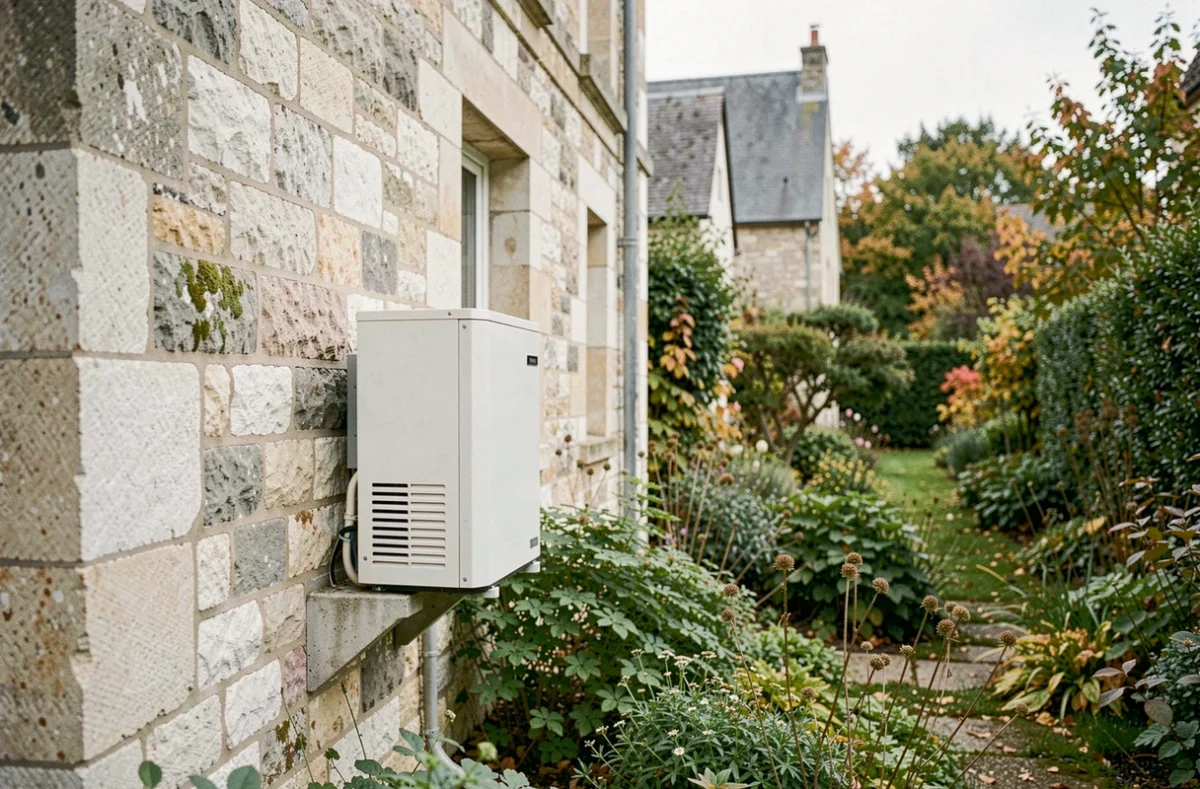
Choosing a heat pump in Caen means weighing up several technical factors before even looking at a catalogue: the type of heat emitters already installed, the actual noise level in real-world conditions, and the timing of grants, whose eligibility requirements change regularly. The goal is not to find “the best heat pump”, but the one whose sizing, placement and financing suit a specific home.
Noise and outdoor unit placement in Caen: the overlooked factor
Competitors’ guides spend a long time comparing heat pump types and SCOP ratings. However, they tend to gloss over an issue that can lead to neighbour disputes: the actual noise produced by the outdoor unit in real-world conditions. In Caen, where narrow courtyards and shared walls are common in older neighbourhoods (Vaugueux, Saint-Jean, Grâce-de-Dieu), sound travels very differently depending on where the unit is installed.
The product specifications state a noise level measured in a laboratory. In practice, sound reverberating between two stone walls can significantly amplify that level. A poorly positioned unit, facing a neighbour’s bedroom or a patio, can turn an appliance known for being quiet into a source of conflict.
Three factors are worth assessing with the installer before signing the quote:
- Airborne noise, which is heard directly and depends on the distance and orientation of the fan relative to nearby openings.
- Vibrations transmitted through the ground or load-bearing wall, which are often overlooked even though they can travel through the building and be felt in adjoining rooms.
- The defrost cycle, which causes temporary increases in noise and occurs more frequently in cold, damp weather—a common climate in Normandy between November and March.
Choosing a suitable anti-vibration mount and carefully positioning the unit matter just as much as selecting the model itself. Asking the installer to provide a layout simulation is a good way to assess how thorough they are.
A comprehensive guide to heat pumps in Caen from Easy Home explains the sizing steps suited to homes in Calvados.

Air-to-air or air-to-water heat pump in Caen: a comparison based on your existing system
The choice between these two technologies depends above all on the equipment already installed in the home. Replacing a gas boiler connected to water radiators calls for a different solution than fitting out an apartment heated by electric convectors.
| Factor | Air-to-air heat pump | Air-to-water heat pump |
|---|---|---|
| Compatible existing system | Electric radiators, no hydronic circuit | Water radiators, underfloor heating, existing gas or oil boiler |
| Cooling function | Yes (reversible, active cooling) | Limited cooling, not air conditioning in the strict sense |
| Domestic hot water production | No | Yes, depending on the model |
| MaPrimeRénov’ eligibility | Not eligible as such | Eligible subject to conditions |
| Connection | Simple (ducted system or wall-mounted splits) | Requires a functioning hydronic circuit |
The air-to-water heat pump remains the go-to solution for energy-efficient renovation in a home with a central heating system. It allows you to keep the existing heat emitters—radiators or underfloor heating—while also providing domestic hot water.
An air-to-air heat pump is better suited to homes without a hydronic circuit. It provides genuine summer comfort thanks to reversible air conditioning. However, it does not qualify for the same financial assistance, which significantly affects the project’s cost-effectiveness.
Financial assistance for a heat pump in Calvados: a changing framework
Eligibility requirements for energy renovation grants have become stricter in recent years. MaPrimeRénov’ remains the main scheme, but its caps, income criteria and rules on combining it with other grants change regularly.
Before signing a quote, make sure to check three things:
- Confirm the chosen model’s eligibility and the grant amount on the official website, as rates sometimes change during the year.
- Check that the installer holds RGE (Recognised Environmental Guarantor) certification, which is required to access MaPrimeRénov’ and the Coup de pouce chauffage scheme.
- Compare the project’s total cost (equipment, installation and commissioning) with and without the grant, rather than relying solely on the monthly payment for a bundled offer, which may conceal a higher overall cost.
When you submit your application affects the amount of assistance you receive. A project completed a few weeks before a change in grant rates may qualify for more favourable terms—or lose out if the application is submitted too late. Finding out early in the process helps avoid unpleasant surprises.

Sizing and performance in Normandy’s climate
SCOP (seasonal coefficient of performance) measures a heat pump’s average efficiency over a full heating season. Air-to-water heat pumps generally have a higher SCOP than air-to-air models, but this figure depends heavily on the average outdoor temperature.
Winters in Normandy are rarely very harsh, but they are often damp and prolonged. Humidity accelerates frost build-up on the outdoor heat exchanger, triggering more frequent defrost cycles. These cycles use energy and temporarily reduce actual efficiency.
Correct sizing by a professional takes these local factors into account. An undersized heat pump relies on its electric backup heater too often, driving up electricity bills. An oversized heat pump runs short cycles that cause the compressor to wear out prematurely. Correct sizing is based on a thermal assessment of the home, not a quick estimate based on floor area.
Whether to choose a high-temperature or low-temperature model depends on the existing heat emitters. Older cast-iron radiators require hotter water than underfloor heating. This technical factor directly affects seasonal efficiency and everyday comfort.
The deciding factor when comparing two similar projects is the total cost over ten to fifteen years: upfront investment, grants deducted, annual electricity consumption and maintenance. An RGE-certified installer who provides this cost projection, backed by a thermal assessment, gives homeowners the information they need to make an informed decision.